
Criminals are exploiting established customer accounts and familiar brands to steal money and personal information, according to TransUnion’s Fraud in the Age of Continuous Trust report. Eighty-one percent of suspected digital fraud in its network during the first half of 2026 occurred during account logins and financial transactions, highlighting risks that persist throughout a customer relationship.
Verifying someone’s identity does not establish whether every subsequent interaction can be trusted. Scammers can manipulate legitimate customers into authorizing fraudulent activity, while fabricated identities that pass onboarding checks can be used across multiple services to obtain credit or facilitate further fraud.
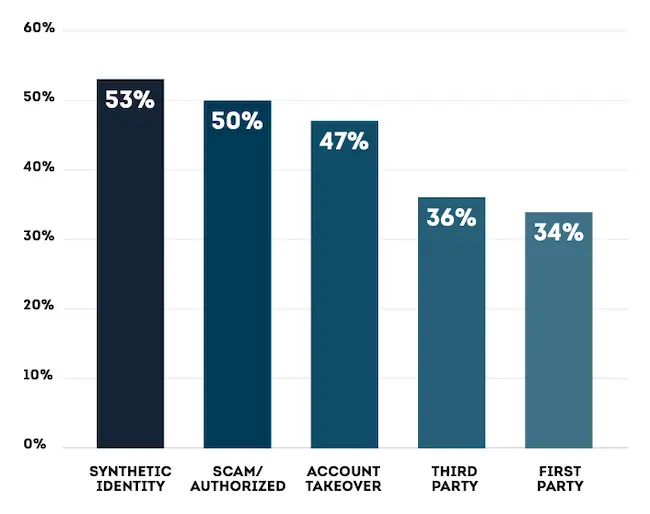
Percentage of business leaders who said their organizations are least prepared to manage each fraud type (Source: TransUnion)
A familiar name on the phone
Impersonation scams often begin with a message or call that appears to come from a bank, insurer or healthcare provider. Criminals disguise the sender’s identity and exploit the organization’s reputation to encourage a response.
The request may sound like a routine security procedure: confirm personal details, share a one-time passcode or reset account credentials. Following those instructions can help an attacker take over an account. Fraudsters may also impersonate legitimate representatives to persuade customers to redirect payments.
These exchanges can take place through communication networks outside a business’s direct control. They can shape a customer’s behavior before fraud checks have an opportunity to intervene.
Scams and authorized fraud were the most commonly cited leading source of business fraud losses, selected by 29% of surveyed fraud and risk decision-makers at large consumer-facing organizations across eight markets. Such schemes can involve manipulating a victim into authorizing fraudulent activity, including a transfer of money.
Fake identities spread across services
Criminals use exposed personal information and AI to construct convincing synthetic identities and fabricated documents. Data breaches provide authentic identity details that can help these creations pass verification.
Once accepted, a synthetic identity can be used across several services. A single identity might be used to obtain a buy now, pay later loan, open a mobile phone account with a handset lease, secure a credit card and create an online betting account.
That activity creates risks beyond the initial application. A fabricated identity that slips past onboarding controls can remain undetected as criminals exploit accounts and business processes.
US lenders had an estimated $2.4 billion in exposure to synthetic identity fraud risk at the end of June 2026. Auto lending accounted for the largest portion, at $1.5 billion. These estimates measure potential lender losses, instead of losses already incurred.
AI reduces the work behind an attack
AI can help criminal groups generate documents, write impersonation messages, create identities and target victims. Automating these tasks reduces the effort required to prepare, repeat and adapt a scheme.
The same operation can draw on stolen credentials, fabricated records and recognizable branding to approach people through different services. Successful attacks can extract funds, credit, merchandise or digital goods. Criminal networks can then move the proceeds through synthetic or legitimate accounts, transfers and resale channels.
Forty-two percent of surveyed business leaders said the increasing scale or sophistication of fraud was placing significant or severe pressure on their organizations.
Account recovery and service requests are also targets. Attackers increasingly seek to exploit secondary authentication processes to gain access to accounts as businesses strengthen login controls.
Regional fraud patterns
In Canada, criminals use stolen credentials, phishing and social engineering to access existing accounts, with logins accounting for the largest share of suspected fraud. In Europe, 88% of suspected digital fraud recorded in the company’s regional network occurred after account creation. UK business leaders most often identified scams and authorized fraud as their leading source of losses, and respondents in Spain identified first-party and third-party fraud as their leading categories.
Across Latin America, expanding mobile commerce and instant payments give criminals more opportunities to target customers, with phone scams the most commonly reported approach experienced by consumers who had been targeted. Account access dominated activity recorded for African clients, accounting for 94.3% of suspected digital fraud.
In Asia, mobile services and instant payments support schemes involving account compromise and manipulated transfers. Business leaders in the Philippines and India identified scams and authorized fraud as their leading source of fraud losses.
from Help Net Security https://ift.tt/8vPyfLh


0 comments:
Post a Comment