.png)
Senior decision-makers are the heaviest users of unapproved AI tools, and they continue using them despite being aware of the security and privacy risks linked to shadow AI, according to TrustedTech’s Shadow AI in the Workplace report. The study found that 65% of decision-makers use shadow AI, compared with 31% of employees below decision-maker level.
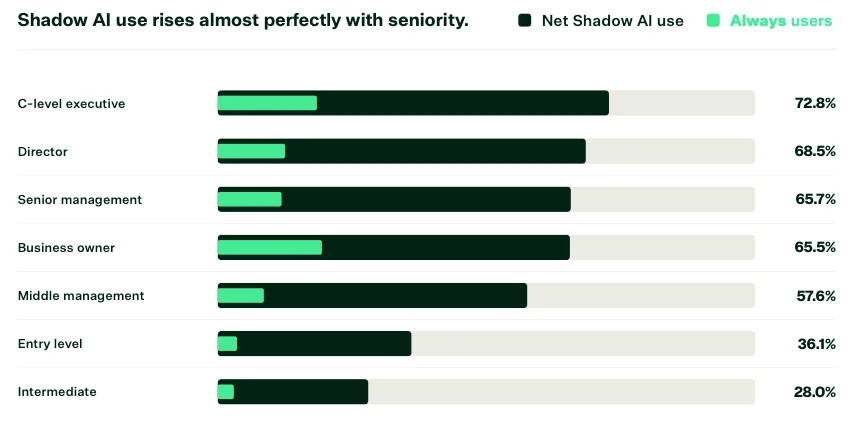
Net Shadow AI use (Source: TrustedTech)
The data suggests that shadow AI is not mainly driven by junior employees experimenting with consumer tools. The people creating policies and overseeing teams appear to be some of the most active users of unapproved AI systems.
Employees continue using AI because they see practical value in it. Around 70% of respondents said AI tools have improved team performance, and more than half reported saving at least three hours a week through AI use.
Most respondents said they understand the risks associated with unapproved AI tools, including security and data privacy concerns. Employees continue using them because approved alternatives do not meet their needs or because organizations have not provided suitable options.
Around 14% of employees said they use AI tools at work without knowing whether those tools are approved by their employer. The number exceeds the share of respondents who said they never use AI at work.
“Organizations have been trying to control employee behavior, but what this data shows is that leadership teams are moving faster than the policies designed to guide them. When executives are using unapproved tools to move quickly, it creates a ripple effect across the entire organization,” said Julian Hamood, Founder of TrustedTech.
Senior employees are driving shadow AI use
Decision-makers were more likely than other employees to believe their organization monitors AI use. Some may avoid approved platforms because they do not want their activity tracked or connected to their name. For employees whose professional reputation depends on appearing knowledgeable and capable, visible AI usage can create concerns about how they are perceived.
The research showed differences between the US and UK. US employees reported slightly higher shadow AI usage, with more intensive use among workers who rely on these tools regularly. The study noted that US organizations often combine formal AI programs with informal workarounds inside the same workplace.
Workers are learning AI on their own
Differences in AI confidence and training exist between senior employees and the rest of the workforce. Nearly 78% of decision-makers said they felt confident using AI tools in their role, compared with 43% of employees below decision-maker level.
Self-learning was the most common source of AI knowledge, with workers relying on videos, blogs, and online resources more often than formal employer training. Employees below decision-maker level relied more on self-learning, while senior employees were more likely to receive structured training.
Around 44% of respondents believe their organization lacks training on how to use AI safely and securely.
Bans may not stop AI use
Restrictions alone may not prevent shadow AI use. Nearly one-third of employees said they would continue using AI tools even if workplace rules prohibited them and disciplinary action was possible.
Employees said they would likely turn to personal AI tools if organizations limited access because of higher software costs.

Download: The IT and security field guide to AI adoption
from Help Net Security https://ift.tt/8jvmAop


0 comments:
Post a Comment